
Study environment and workspaces at the accessibility services (ZAB)
Content: Design of the study environment, ZAB student workspaces, Recommendations for you as teaching staff.
Design of the study environment
Libraries and study rooms are not suitable places for all students to revise course material, let alone to learn it. Some students, due to impairments, chronic or mental illnesses rely on portable tools and/or permanently installed technical assistive devices, as well as furniture that meets specific ergonomic requirements beyond standard fittings, whilst studying independently. The design of a suitable workspace is varied and is always tailored to the individual needs of the person in question.
Requirements for an accessible learning environment may include:
- adequate, glare-free and individually adjustable workplace lighting;
- height-adjustable desks and ergonomically designed standing or sitting options;
- good air quality through ventilation or air purifiers;
- individual room blackout;
- a low-stimulus environment (e.g. avoiding synthetic fragrances, using partition walls);
- a quiet working environment and noise-reduced infrastructure;
- Capital-letter keyboard;
- assistive technologies such as screen readers;
- Braille printer;
- and a braille display.
The ZAB student workspaces at Bielefeld University serve as best-practice examples in this regard.
ZAB student workspaces
Facilities
Depending on their needs, students can use either the low-stimulus Theresia Degener Room or the workstations for blind and visually impaired students in the Louis Braille Room.
Theresia Degener Room
The Theresia Degener Room is located in ‘UHG B1-241’ and is available to students who require a low-stimulus working environment. The four workstations are intended for individual, quiet study and are complemented by a separate area with comfortable seating.
Room facilities:
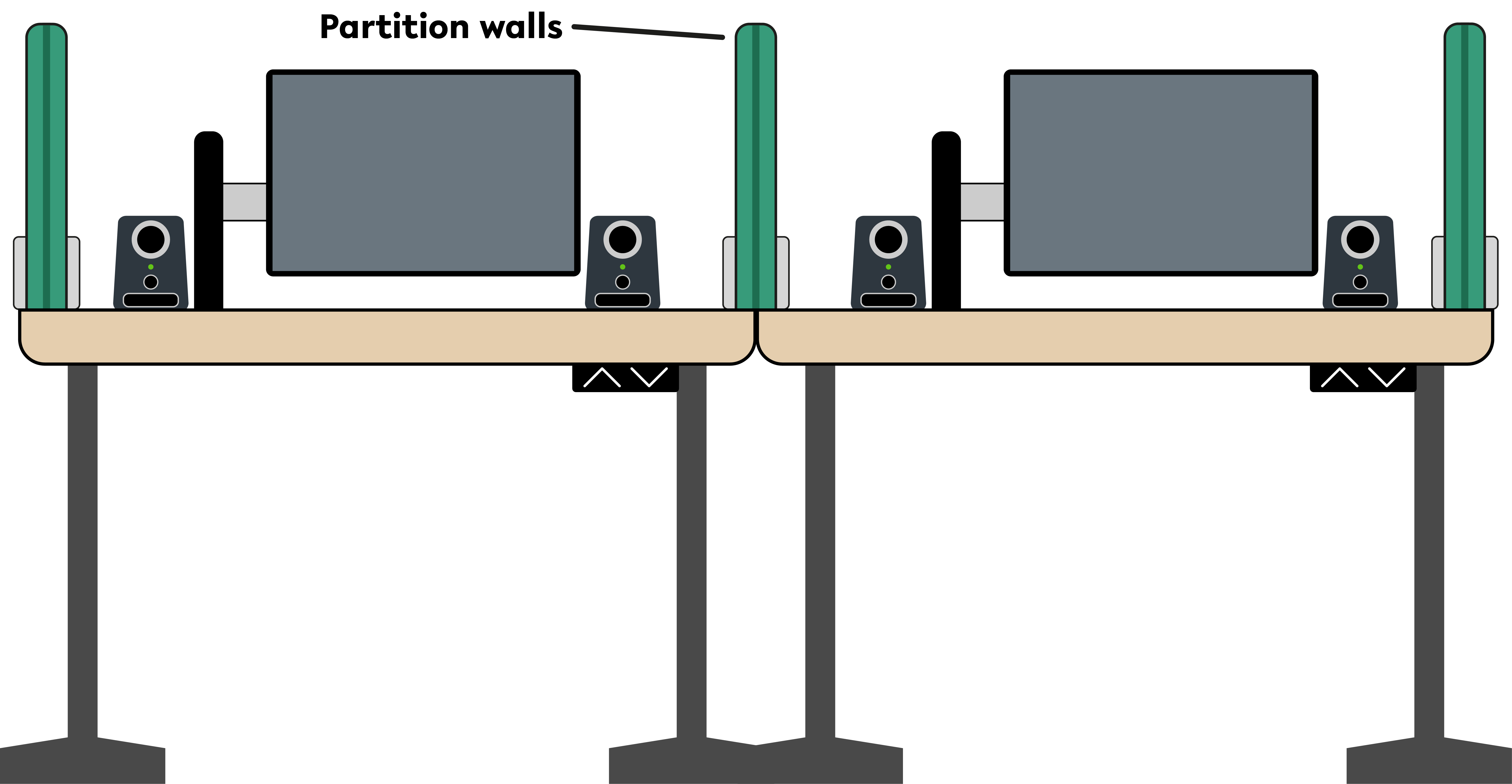
- height-adjustable desks;
- monitors on swivel arms;
- adequate workplace lighting;
- earplug dispensers;
- and partitions to reduce noise.
Should anyone wish to use this low-stimulus room, all users undertake to refrain from using synthetic fragrances – such as perfumes, hairsprays, aftershaves or strongly scented cosmetics – on the day of use. Furthermore, mobile phones must be set to silent mode during the session.
The additional rules of use are intended to minimise distractions within the study area as much as possible, in order to make studying there as comfortable as possible for all students. People on the autism spectrum or students with certain mental illnesses, for example, rely on such a low-stimulus environment. In addition, people with allergies also benefit from an environment that is as free from allergens as possible.
The following video will give you an idea of the room and its facilities:
[Video mit Englischen Untertiteln einfügen]
Louis Braille Room
The Louis Braille Room is located in ‘UHG B1-243’ and provides a total of four workstations for blind and visually impaired students. It can be used both by students with relevant needs and by their (personal) assistance.
Room facilities:
- height-adjustable desks;
- monitors with swivel arms;
- adequate workplace lighting;
- partition walls to reduce noise;
- and text-to-speech and magnification devices.
The workstation for blind students is equipped with the following assistive devices:
- Loudspeakers;
- Braille display (80 characters, 8-dot)
- and Braille printer.
The workstation for visually impaired students is equipped with the following assistive devices:
- Loudspeakers;
- large-print keyboard
- and OCR-capable scanner.
The following video will give you an idea of the room and its facilities:
[Video einfügen]
The technical equipment in the rooms is regularly serviced and updated.
Eating is not permitted in either room. However, if students require regular meals for medical reasons, such as diabetes, the food must be chosen and packaged in such a way that other users are not disturbed where possible and no food scraps are left in the room.
Drinking is permitted in both rooms. However, due to the technical equipment in the workrooms, open drinks may not be taken into them. Bottles with sports caps or other containers that can be resealed immediately are permitted.
Access and opening hours
Access to the study rooms is only possible with a token. To obtain one, students with impairments, chronic or mental health illnesses must contact the ZAB at zab@uni-bielefeld.de and explain their needs.
Once their eligibility to use the facilities has been confirmed and they have signed a user agreement, students will be issued with a token to access the relevant study room. If necessary, students will be given guidance on how to use the relevant assistive technologies and tools in the Louis Braille Room.
The study rooms can then be used at any time.
Exams
Students with impairments, chronic or a mental illnesses may also use the examination rooms as part of disadvantage compensation measures. Room bookings for examinations by the relevant department should be made as early as possible via zab@uni-bielefeld.de – but no later than two weeks before the examination date. If the booking is made late, the use of the room cannot be guaranteed.
Recommendations for you as teaching staff
As a member of teaching staff, you too can help ensure that students find suitable, accessible learning environments, enabling them to successfully complete their studies. Find out what support is available at your university and refer students to these services. Without having to ask specifically about individual needs, you can demonstrate an open attitude towards diverse learning and working requirements by displaying such options at the start of the semester in your course. Communicate both the available facilities and the option to borrow and use assistive technologies. In addition, you can help to ensure a relatively quiet and low-stimulus environment within your courses by avoiding disruptive noises and strong odours.
It is also important to bear in mind that students with impairments and/or illnesses may require rooms tailored to their needs as part of disadvantage compensation during examinations. Please discuss this with the students at an early stage.
No comments to display
No comments to display